
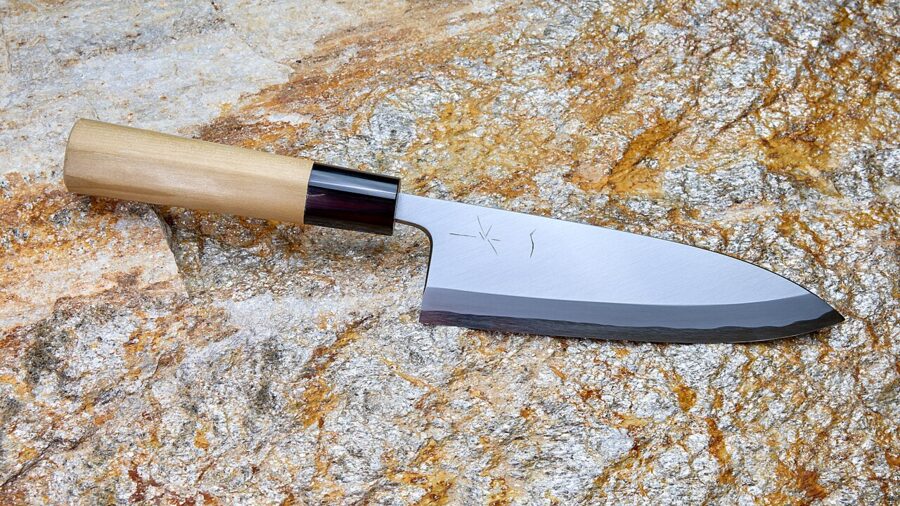
A Sakai deba passes through three workshops before it ever touches a fish. A smith forge-welds a strip of hard steel onto soft iron and hammers out the blade, a sharpener spends longer at the stones than the smith spent at the fire, and a third craftsman drives the hot tang into a wooden handle. In Japan the result is simply a hocho (包丁), a kitchen knife, and you can now take a turn at every one of those stages yourself.
The gyuto, santoku and deba in any guide to Japanese knives all start in a forge, and the gap between a ¥5,000 (about $30) factory blade and a ¥50,000 (about $305) hand-forged one opens in the next few hours of hammering, quenching and grinding. Here is that work step by step, the towns where you can watch it, and the workshops where you can make a knife of your own, as of November 2026.


In this article
From two metals to one blade
Forge welding: hard steel onto soft iron
Most hand-forged Japanese kitchen knives are awase (合わせ), “joined” blades. In the Sakai cutlery federation’s account of the forging, the smith heats soft iron, jigane (地金), until it glows, lays on it a strip of hard carbon steel, hagane (鋼), coated in a flux of borax, boric acid and iron oxide, and fires the pair again. Then he hammers them into a single bar.
Hard steel holds a fine edge but snaps on its own; soft iron bends instead of breaking. Weld a thin strip of the first to a body of the second and the blade is hard where it cuts and forgiving everywhere else. Sakai City puts the forging skills at ten to fifteen years or more to learn.
Single-bevel knives like the deba carry the steel on one face. Most double-bevel knives put it in the middle, clad on both sides in softer iron or stainless, a build sold as sanmai, “three layers”. A few blades, honyaki (本焼き), are one piece of high-carbon steel with no iron at all, harder to make, harder to quench without cracking, and priced to match.
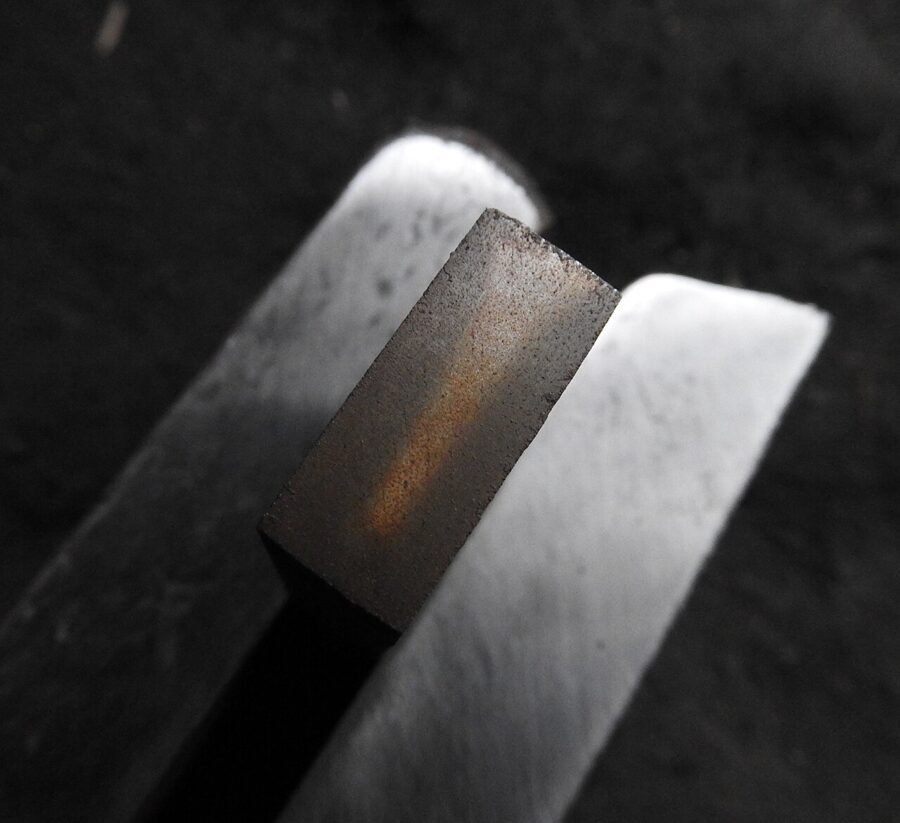

Many factories, and most beginner classes, skip the weld by starting from fukugozai (複合材), bar stock bonded before it reaches the smith. Sanjo Kaji Dojo uses it for its one-day course and keeps forge welding for its two-day one, so if seeing the join is the point of your trip, ask before you book.
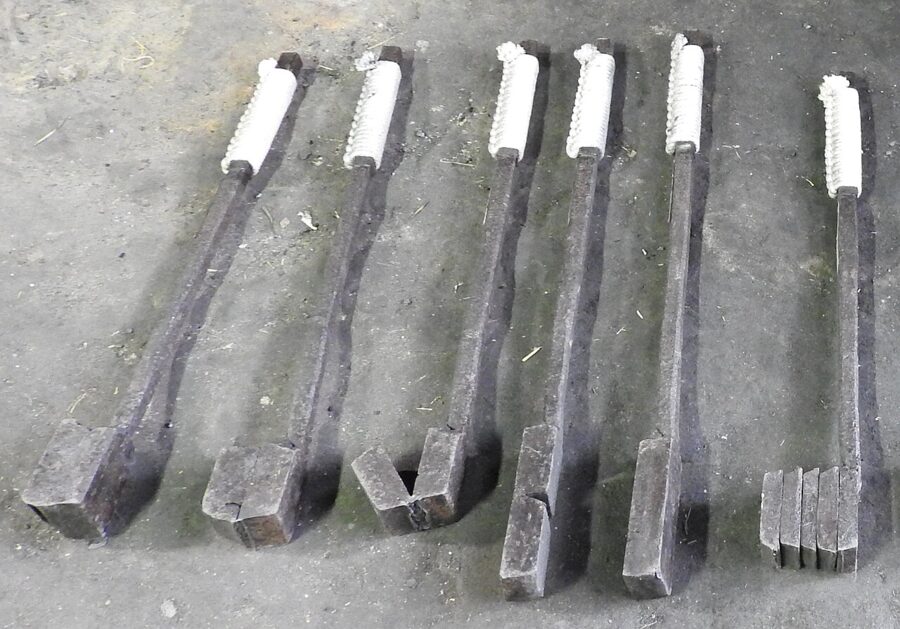

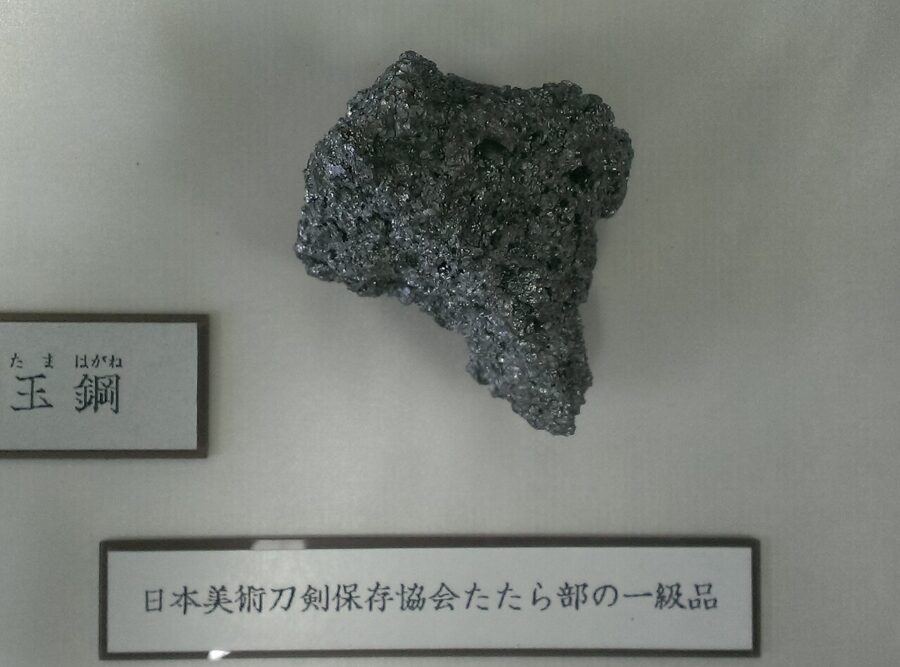
The steel usually comes from a mill: the white and blue paper steels from the Yasugi works in Shimane, once Hitachi Metals and now Proterial, and VG-10 and SG2 stainless from Takefu Special Steel in Echizen. The exception is tamahagane (玉鋼), smelted from iron sand in a clay tatara furnace, which a few workshops will let you make yourself.

Shaping, annealing and the hollow back
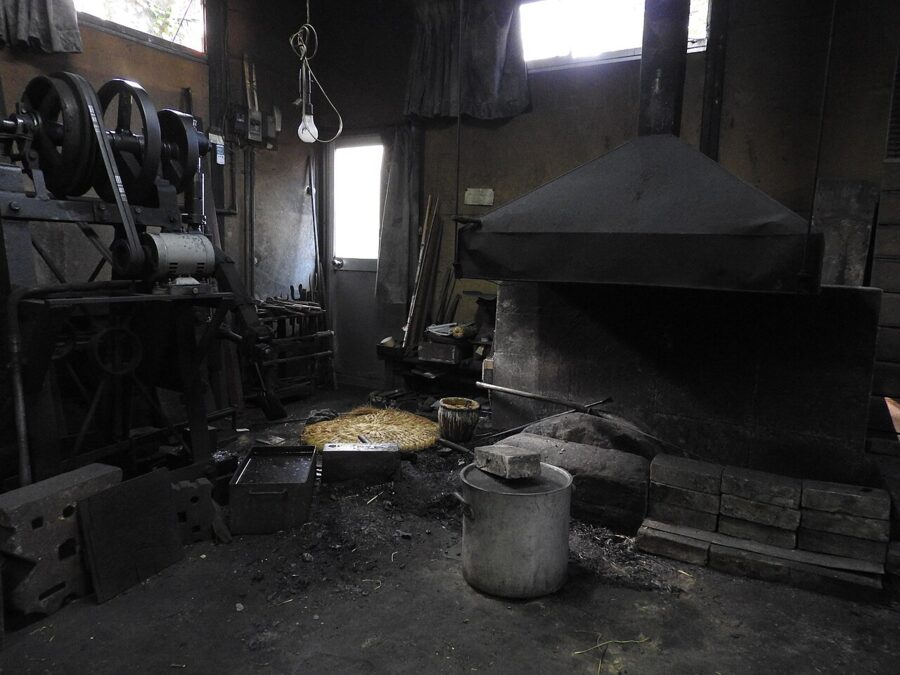
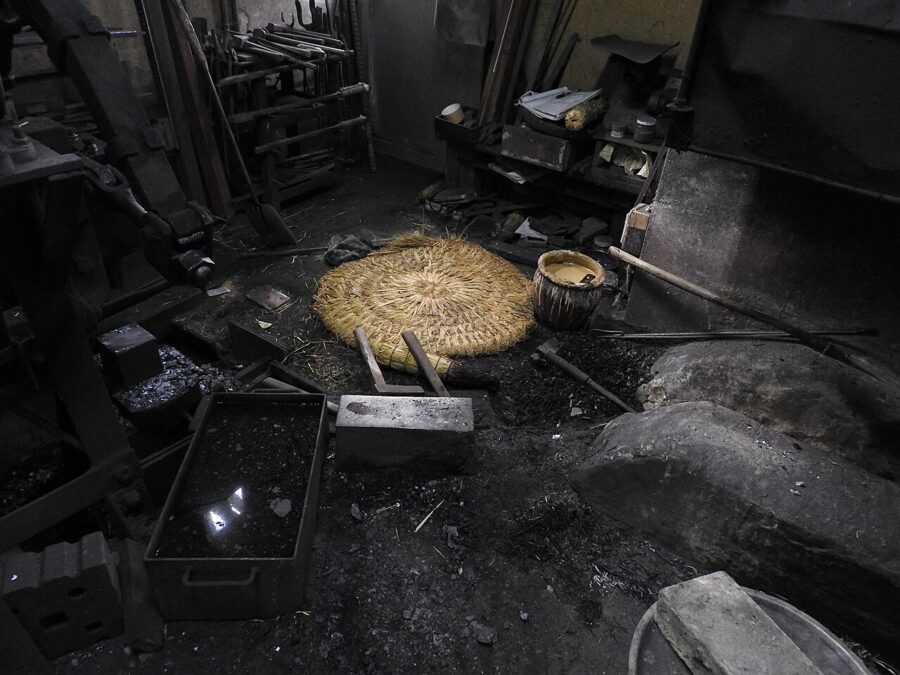
The smith draws the welded bar out under a power hammer into the rough shape of a knife, cuts it free with a chisel and hammers out the nakago, the tang that will sit in the handle. Then the blade is buried in rice straw, which burns down to ash around it so the metal cools slowly and softens. That is the annealing, yakinamashi.
Next the scale is knocked off and the blade hammered again. On a single-bevel knife the smith grinds a shallow hollow into the steel side, the urasuki, which lets the blade release what it cuts. A final hammering packs the metal and takes out warps, the profile is trimmed to a template, and the maker’s mark is struck.

Clay, fire and water: the quench
Hardening makes or ruins a knife. The smith paints the blade with a thin coat of mud, doronuri, dries it by the forge, heats it to 750 to 800°C and plunges it into water. The mud stops large bubbles forming against the steel, so it cools fast and evenly and the hagane turns hard.
Steel straight from the quench is brittle, so the blade goes back into the fire for tempering, yakimodoshi. The old test is to drip water on it and read the temperature from how the drops skitter; many Sakai workshops now use a machine held at 160 to 180°C. The smith then taps out any warp on a wooden block. A honyaki blade is quenched the way a sword is, with clay thick on the spine and thin at the edge, the craft described in Japanese sword making.

The stones: grinding, sharpening and the kasumi finish
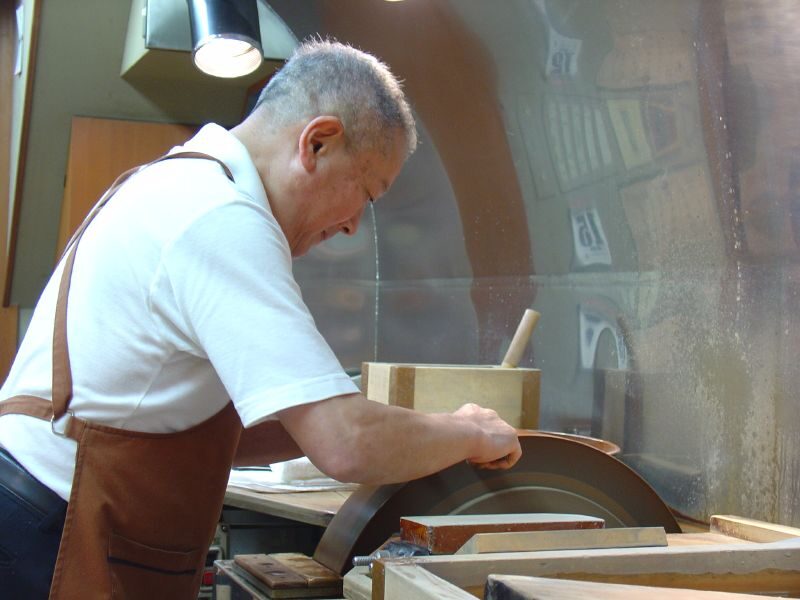
In Sakai the blade now goes to the sharpener, and the federation lists his stages as closely as the smith’s. In aratogi the knife is clamped in a wooden jig and levered against a big rotating stone to set the edge angle. Buffing wheels refine the scratches, the edge is ground in, and a wooden wheel charged with emery powder gives the hollow back its fine surface.
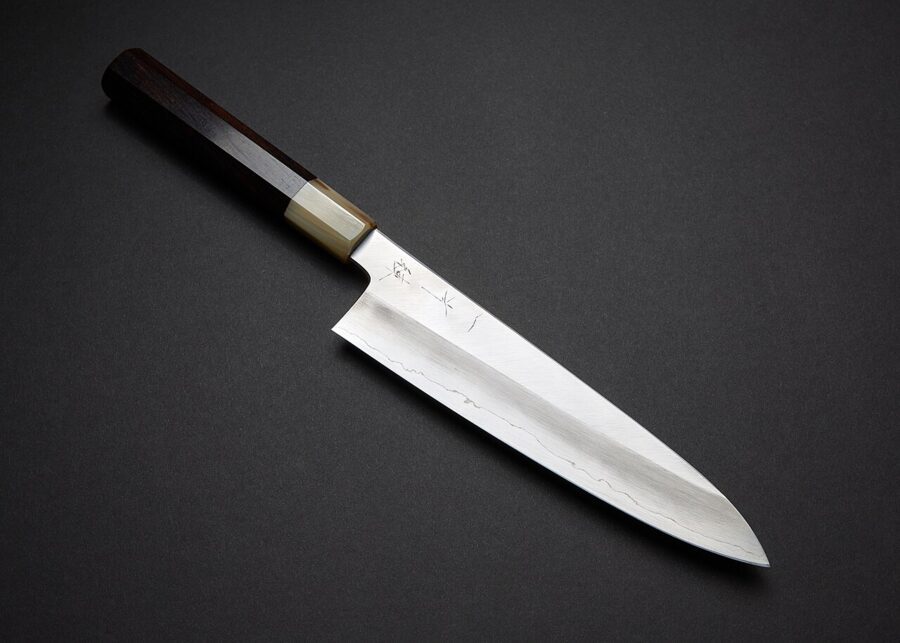
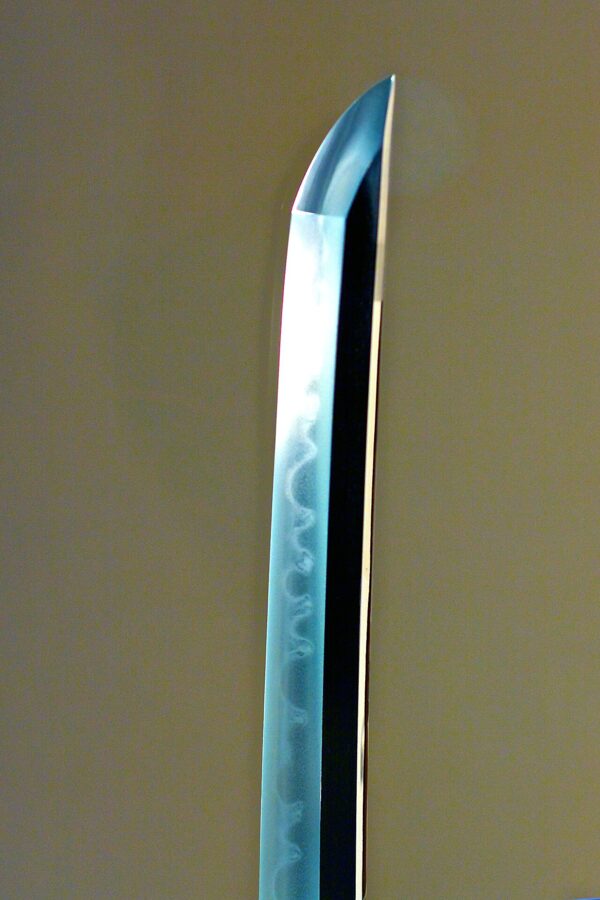
Then the sharpener rubs the bevel with whetstone slurry on a piece of rubber. The iron clouds and the steel stays bright, and the soft line between them is the kasumi (霞), “mist”, finish of a Sakai knife. A fine stone takes off the burr and the blade is oiled. Sakai City counts more than ten steps in this stage alone.

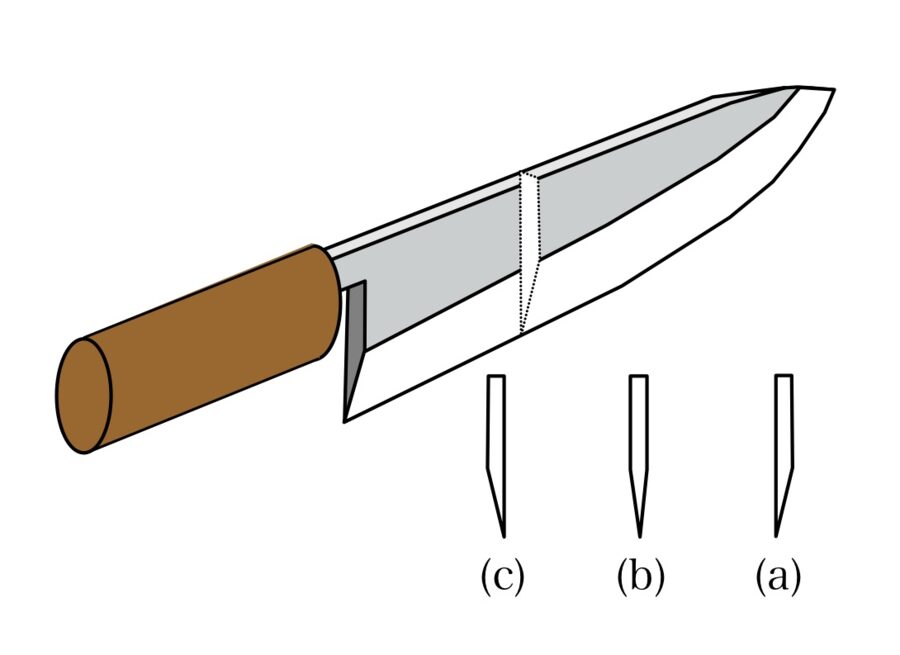
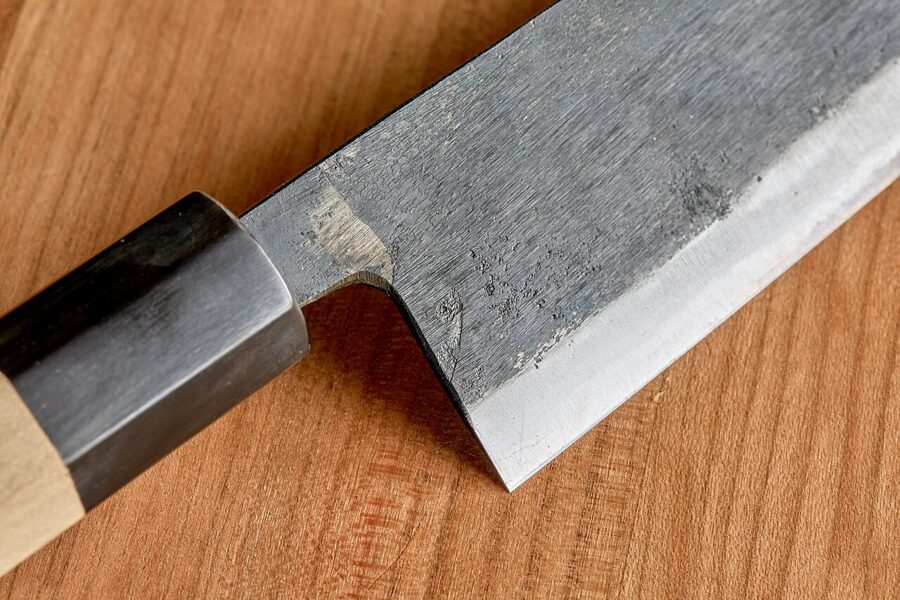
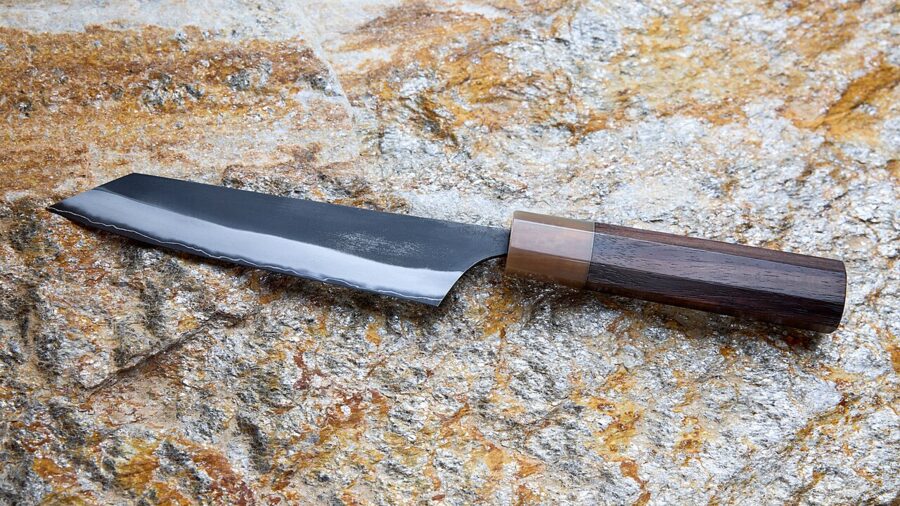
Not every knife gets the polish. Many smiths, in Tosa especially, leave the black forge scale, kurouchi (黒打ち), on the upper blade and grind only the bevel. It costs less and leaves the hammer marks in plain view.

The handle
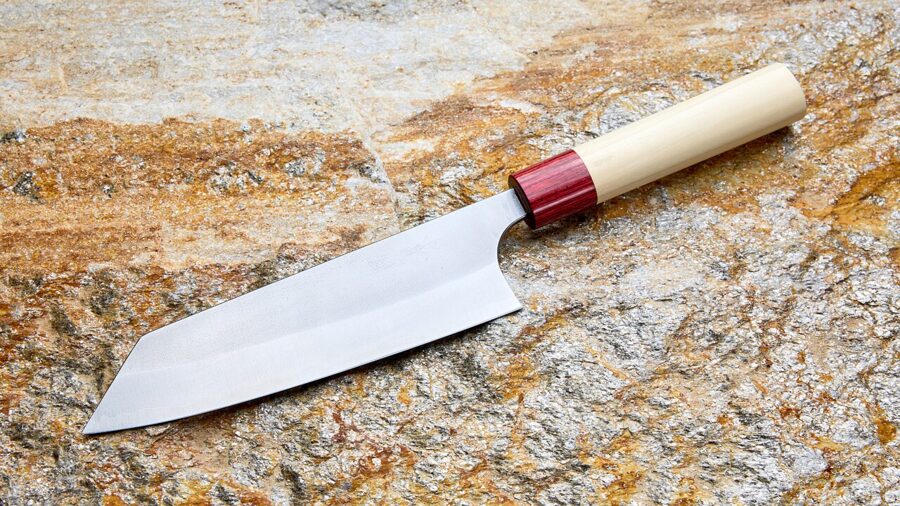
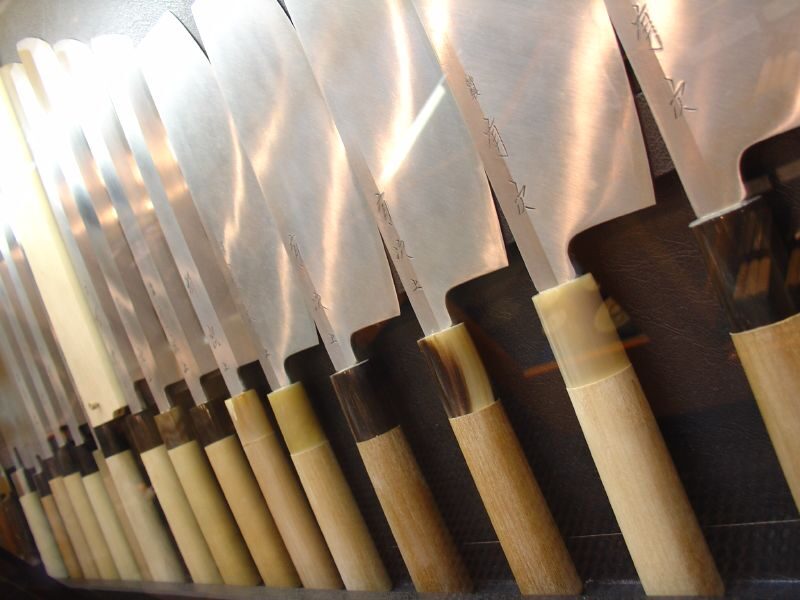
The traditional wa handle is a separate piece of wood, often magnolia, with a ferrule of horn or resin. The craftsman heats the tang, sets it into the handle and taps the butt with a wooden mallet until the blade seats. Sakai City notes that handles have their own specialists, whose job is to set the blade dead straight and balance the knife.

Three trades in Sakai, one pair of hands elsewhere
Sakai has split forging, sharpening and handle-fitting between separate workshops for centuries, which is why its knives often carry two names. Elsewhere the smith more often forges and grinds his own blades. In Tosa the tradition is jiyu tanzo, free forging by eye without dies or templates, so one forge can turn out a gyuto, a sickle or a hatchet.
Neither system is better in itself. For a single-bevel knife I would want a Sakai sharpener’s work, because the flat back and even hollow are the hard part; for a gyuto, a one-smith workshop gives you a knife that one person answered for from fire to edge.
The knife towns, and where to watch the work
Six places carry most of the trade: Sakai, Seki, Echizen, Tsubame-Sanjo, Tosa and Miki. All but Seki hold the national designation among Japan’s traditional crafts for their cutlery, and each shows its work differently.
Sakai, Osaka
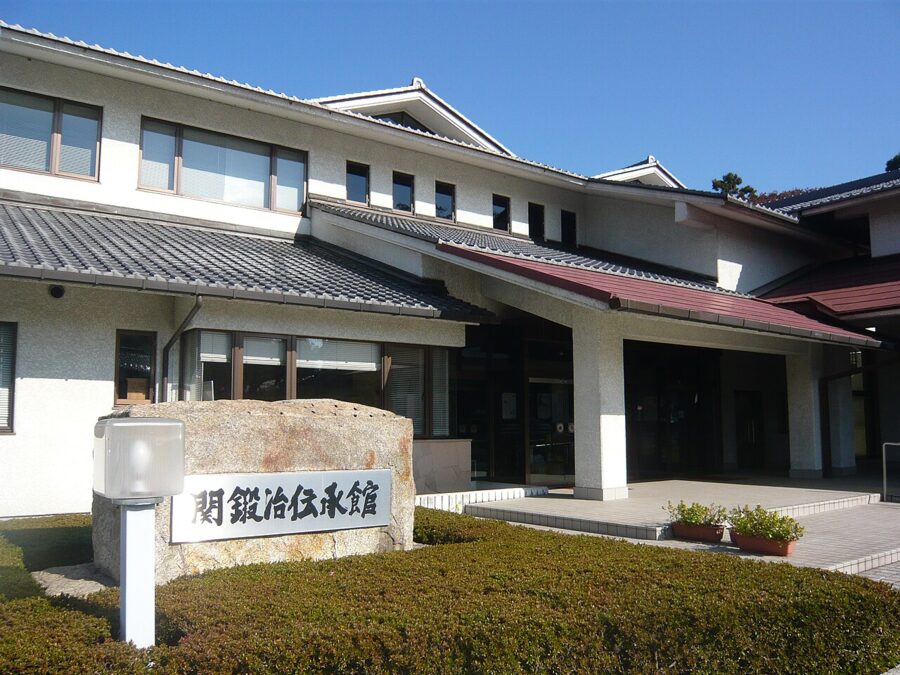
Sakai’s knives began with blades for cutting tobacco in the sixteenth century, and Sakai uchihamono was designated a national traditional craft on 5 March 1982. Start at Sakai Densho-kan, the crafts hall in Sakai-ku, which sells knives from the city’s makers. It opens 10:00 to 17:00 and closes on the third Tuesday (the next day if that is a holiday) and from 29 December to 3 January, as of November 2026.
The day to see smiths in public is the Sakai Hamono Matsuri, free, held on 11 and 12 April in 2026 with old-style forging at 10:30 and 13:30 and a sharpening clinic from ¥1,400 (about $8) a knife. The 2027 dates had not been posted in November.
Seki, Gifu
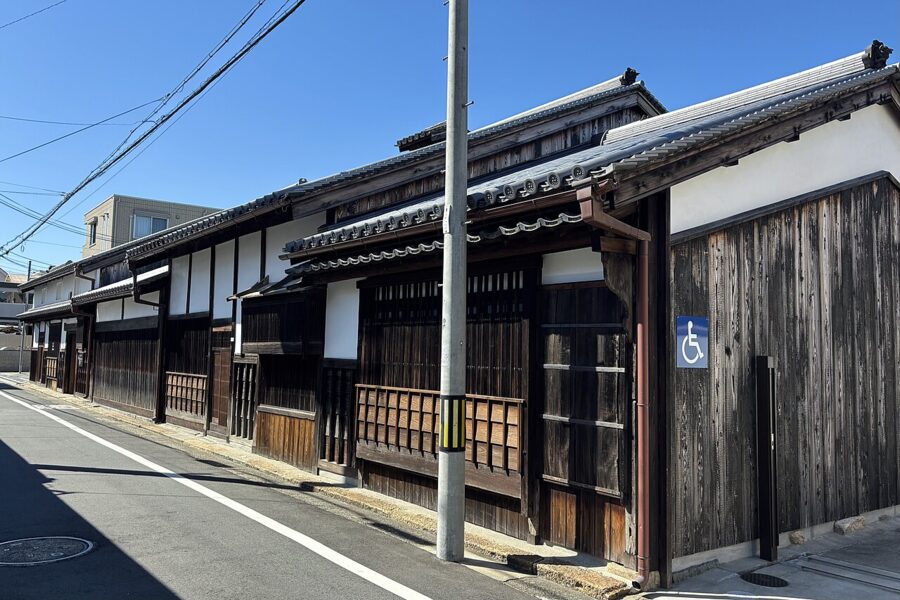
Seki was a sword town from the Kamakura period and turned to pocket and kitchen knives when the sword trade died. It is now a town of large factories, with fewer small forges that take visitors. Its sword museum, the Seki Kaji Denshokan, is closed for renovation from 7 September 2026 to 31 March 2027, but the forging hall stays open.
Swordsmiths forge there in public on the first Sunday of February to September, November and December, at 10:30 and 13:30, with a New Year forging at 10:00 on 2 January and extra sessions during the October cutlery festival. Adult admission was ¥300 (about $2) before the closure.

Echizen and Takefu Knife Village, Fukui
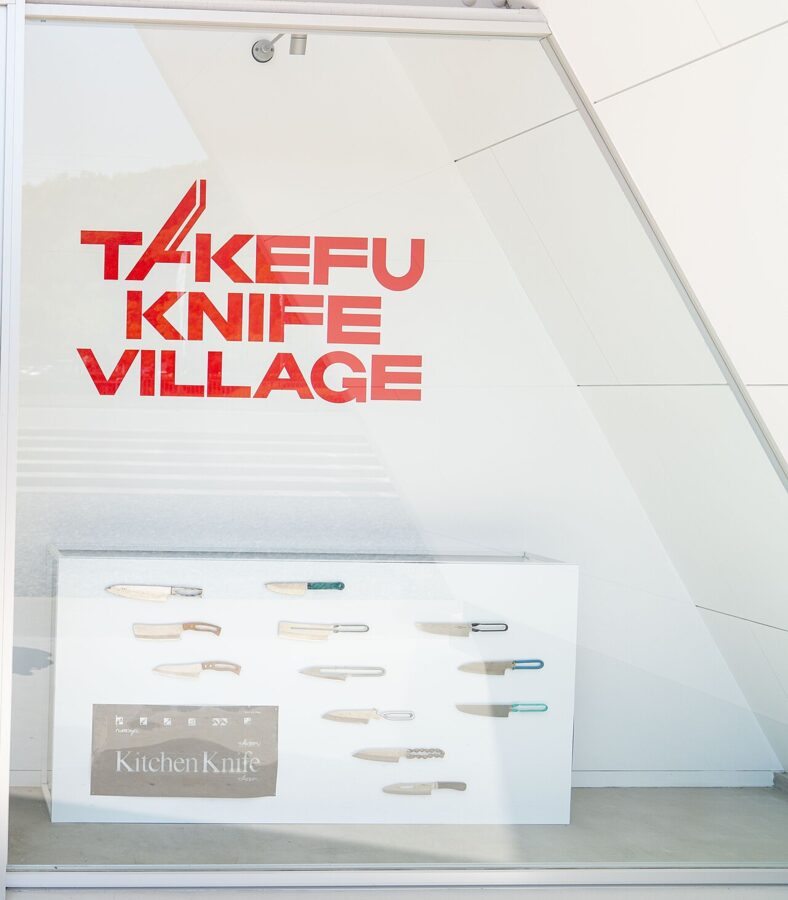
By the 1970s stainless steel and stamped knives were finishing off Echizen’s smiths. A group of young ones began meeting after work in 1973, the designer Kazuo Kawasaki joined them in 1982, and the shared brand they launched that year was Takefu Knife Village. In May 1993 ten companies opened its building, designed by Kiko Mozuna and paid for, the cooperative says, with ¥30 million (about $180,000) of debt per member.
It is still the best place in Japan to watch kitchen knives forged. The museum and factory floor are free to look into, and the shop sells the members’ knives. It opens 9:00 to 17:00 with irregular closing days, so go on a weekday. At midnight on New Year the cooperative holds Hatsuuchi, three smiths in white robes forging one blade the old way; the next is 0:00 to 1:00 on 1 January 2027, grounds open from 23:00.

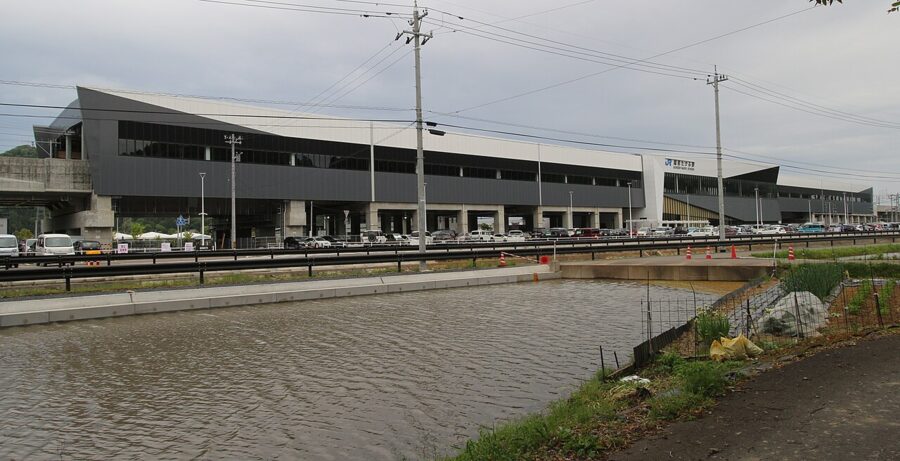
The village is about 10 minutes by car from Echizen-Takefu Station on the Hokuriku Shinkansen, or 20 from Takefu Station on the Hapi-Line Fukui.

Tsubame-Sanjo, Niigata
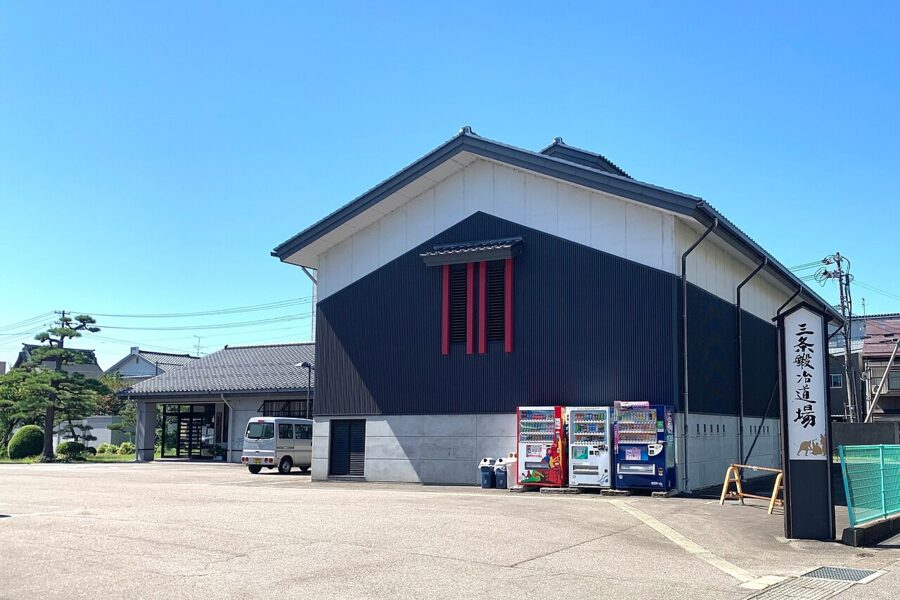
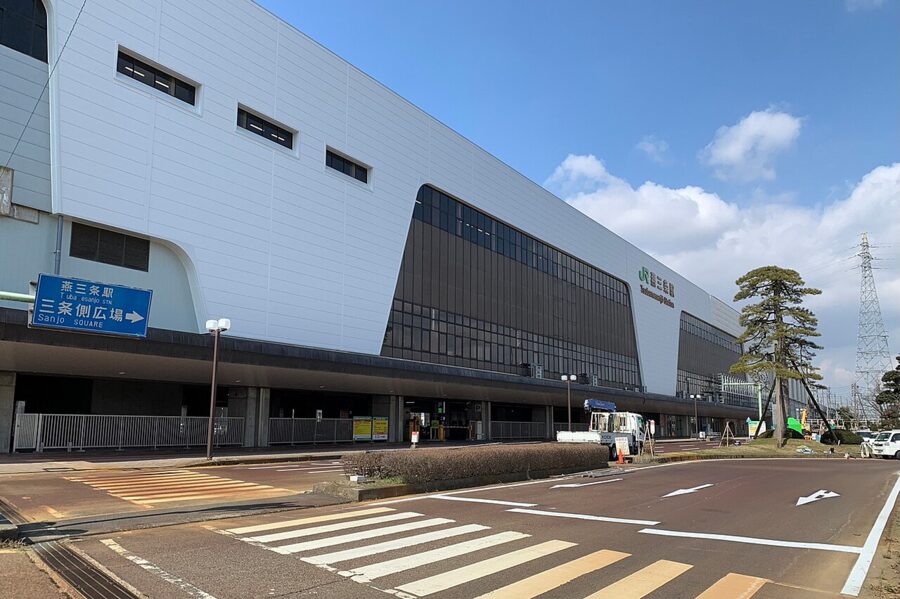
Sanjo’s smithing grew out of nails, made from 1625 as a side income for flood-hit farmers and turned into a full trade by the demand after Edo’s great fire of 1657. Echigo Sanjo uchihamono was designated a national traditional craft in April 2009. Sanjo Kaji Dojo, the city’s blacksmithing hall, is three minutes’ walk from Kita-Sanjo Station, open 9:00 to 17:00, closed on Mondays and from 29 December to 3 January.


Tosa, Kochi
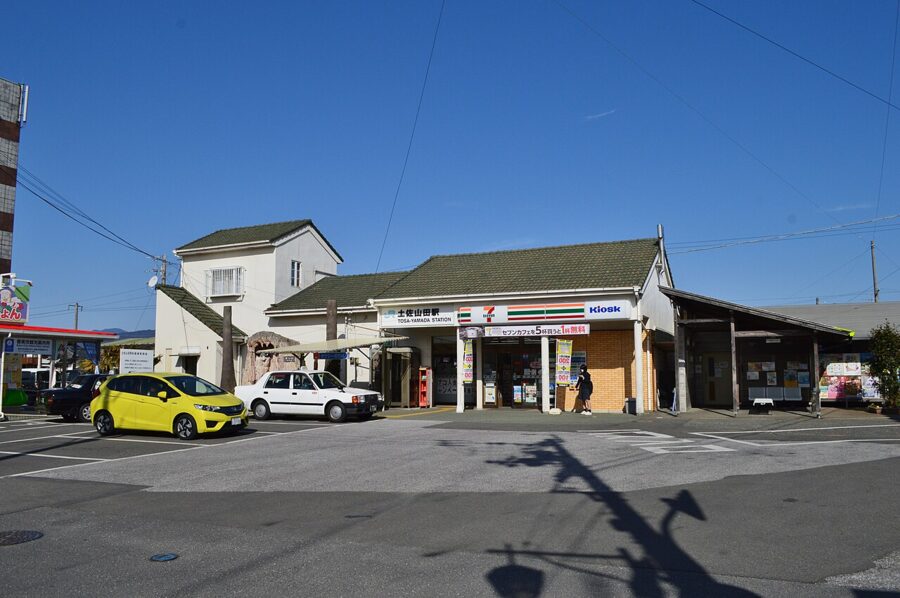
Tosa uchihamono is centered on Tosayamada in Kami, east of Kochi City, where smiths still forge by eye. The forge that takes visitors, Workshop Kurogane, is far to the west in Shimanto City.
Miki, Hyogo
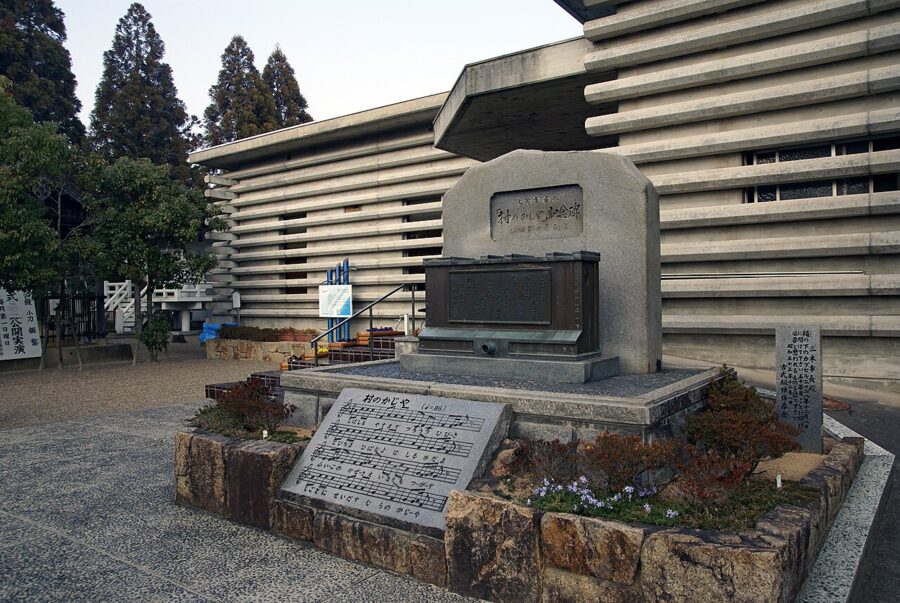
Miki is a town of carpenter’s tools more than kitchen knives: saws, chisels, planes and the small kogatana, the tools behind Japanese joinery. The Miki City Hardware Museum takes last entry at 16:30. The Miki Kanamono Matsuri ran on 7 and 8 November 2026 and added a memorial service for worn-out blades.

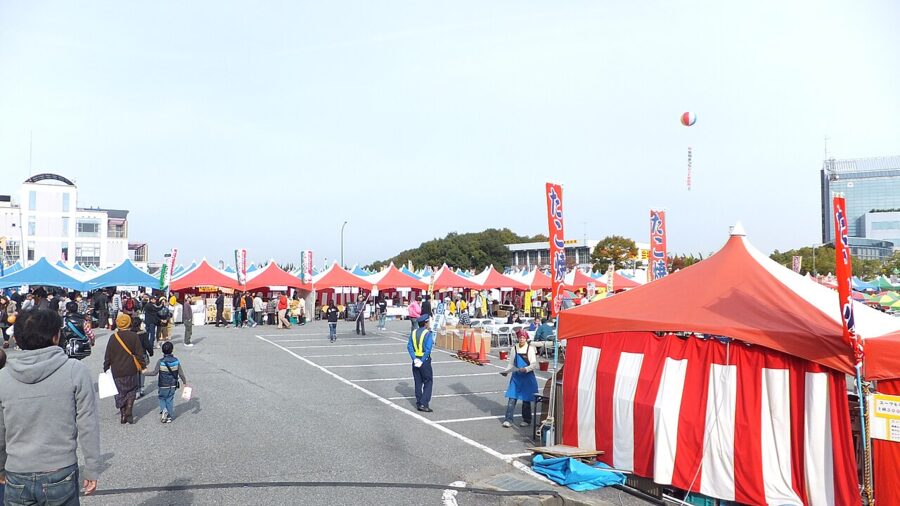

Workshops where you can make your own knife
The classes come in three kinds. A forge-your-own day runs six to eight hours and puts the hammer in your hand. A finishing class takes two or three hours on a blade someone else forged, and a walk-in session takes an hour and costs less than lunch.
| Workshop | Where | Length | Language | Price (November 2026) | Knife home |
|---|---|---|---|---|---|
| Takefu Knife Village, santoku course | Echizen, Fukui | 6 hours | English (translator included) | ¥35,000 (about $210) | Same day |
| Asano Kajiya, one-day knife | Hashima, Gifu | 5 to 6 hours | English | ¥65,000 (about $395) alone; ¥52,000 each for four or more | Same day |
| Workshop Kurogane, one-day knife | Shimanto, Kochi | About 7.5 hours | English or Japanese | ¥44,000 (about $265); ¥48,000 from March 2027 | Shipped after finishing |
| G. Sakai knife museum, Damascus knife | Seki, Gifu | About 2 hours | Japanese | ¥50,000 | Same day |
| Wada Shoten, sharpening and handle | Sakai, Osaka | 2.5 hours | Japanese; interpreter plan | From about ¥18,750 (about $115) | Same day |
| Sanjo Kaji Dojo, walk-in sessions | Sanjo, Niigata | About 90 minutes | Japanese | ¥770 to ¥2,200 (about $5 to $13) | Same day |
Takefu Knife Village: forge a santoku in a day
The cooperative’s own smiths teach. In the course for overseas visitors you heat the steel, forge it under a belt hammer, then quench, sharpen, engrave and handle a santoku. It runs six hours from 9:30, costs ¥35,000 (about $210) with a translator, and is for ages 18 and up.
Shorter options run one to two hours: a sharpening course where you finish and handle a knife for ¥17,000 (about $105), and a factory tour with a go at forging for ¥13,000 (about $80). You take everything home the same day. Book ahead through the site; group classes are suspended.
Asano Kajiya, Hashima: with a swordsmith
Asano Kajiya is the forge of the swordsmith Fusataro, born in Gifu in 1976. He trained for six years under Fujiwara Kanefusa, 25th of that line, set up in Seki in 2004, moved to his home town of Hashima in 2006 and began taking visitors in 2015.
His one-day course takes you through hammering, filing, hardening and sharpening a small utility knife in five to six hours, lunch break included. Rakuten Travel Experiences lists it, and the price falls with group size: ¥65,000 (about $395) for one person, down to ¥52,000 (about $315) each for four or more. A two-day course makes a kitchen knife and a seven-day one a tanto from tamahagane, with no prices on the site.
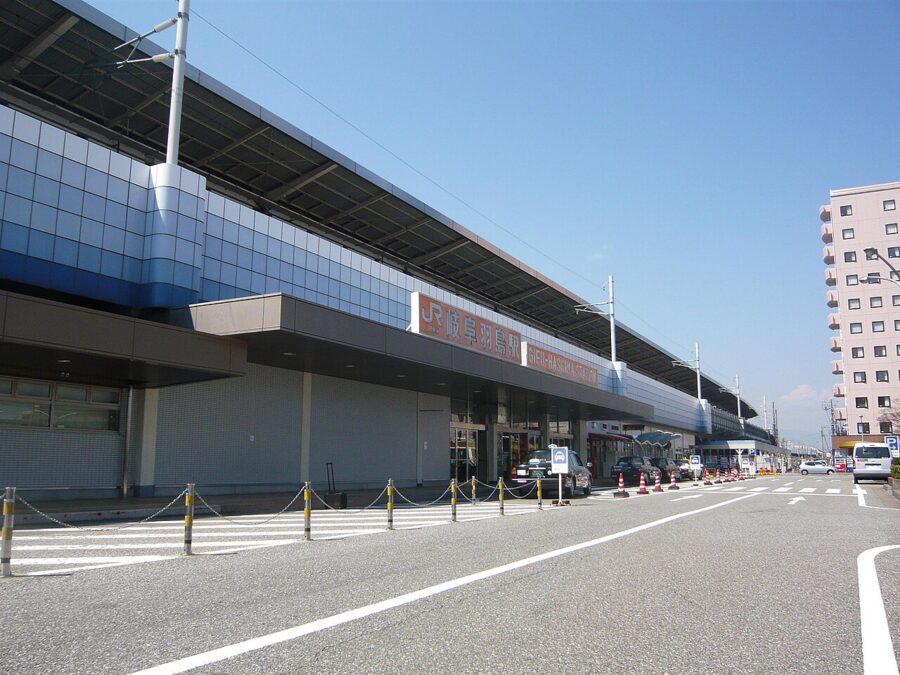
The forge is a 16-minute walk from Gifu-Hashima Station on the Tokaido Shinkansen and closes on Sundays and public holidays. Fusataro teaches in English, and you leave with the knife.

Workshop Kurogane, Shimanto: forge it, then wait for the post
Workshop Kurogane has been run since 2011 by Nobuya Hayashi, who teaches in English. On the one-day course you forge, grind and heat-treat a knife of your own design in modern knife steel. It runs on Fridays and Saturdays from 9:00 to about 16:00 and costs ¥44,000 (about $265) through 2026 and ¥48,000 (about $290) from March 2027, tax and shipping included.
The workshop does the final sharpening and polishing in the days after and ships the knife to you, so you fly home empty-handed and receive a finished blade. Bring lunch: there are no shops nearby. A six-day course smelts tamahagane from beach-sand magnetite and forges a knife from it, for ¥330,000 (about $2,000), or ¥440,000 (about $2,670) from March 2027, without meals or lodging.
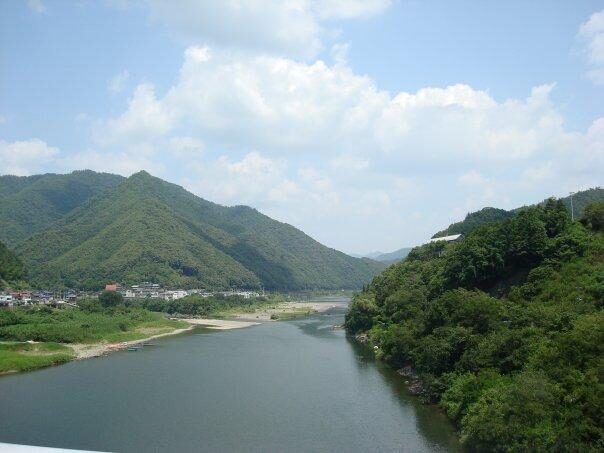

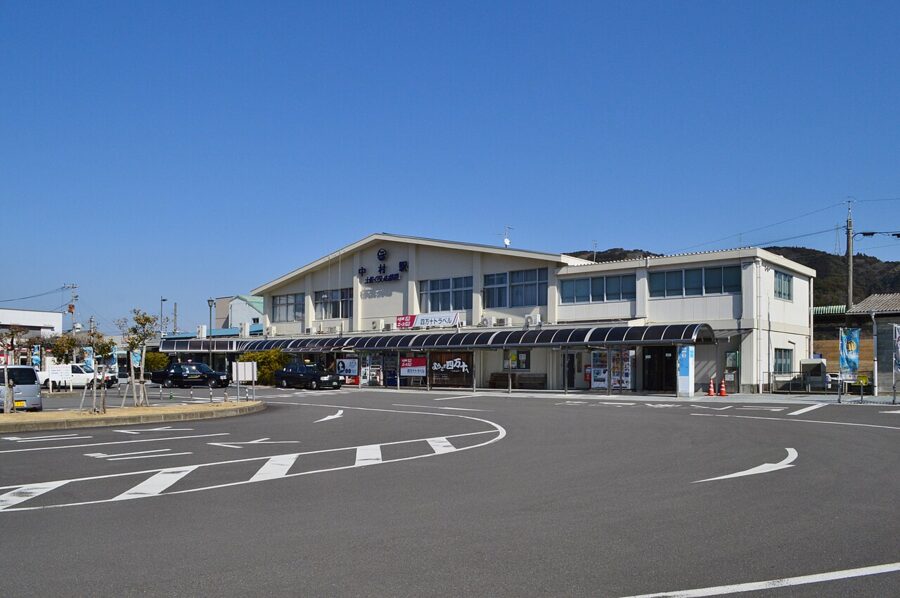
Take the Dosan Line from Kochi to Nakamura Station, then a 45-minute bus to Kuchiyanai (none on Sundays) and a 20-minute walk. On a Japan Rail Pass you pay ¥2,000 (about $12) extra for the private line from Kubokawa.
Seki: a Damascus knife at the knife museum
The knife museum of the Seki maker G. Sakai runs a class in which you make a Damascus hunting or kitchen knife from assembly to polishing, with a factory visit. It is listed at ¥50,000 and taught in Japanese. The layered blade arrives ready-made; you grind, finish and assemble.
Sakai: sharpen and handle your own at Wada Shoten
Wada Shoten, a Sakai tool dealer for 150 years, runs the classic finishing class. You choose a petty, deba, sashimi or all-purpose knife, sharpen it with a craftsman and fit the handle yourself, in about two and a half hours. Classes start at 13:00 or 15:00 on weekdays and 10:00, 13:00 or 15:00 on Saturdays.
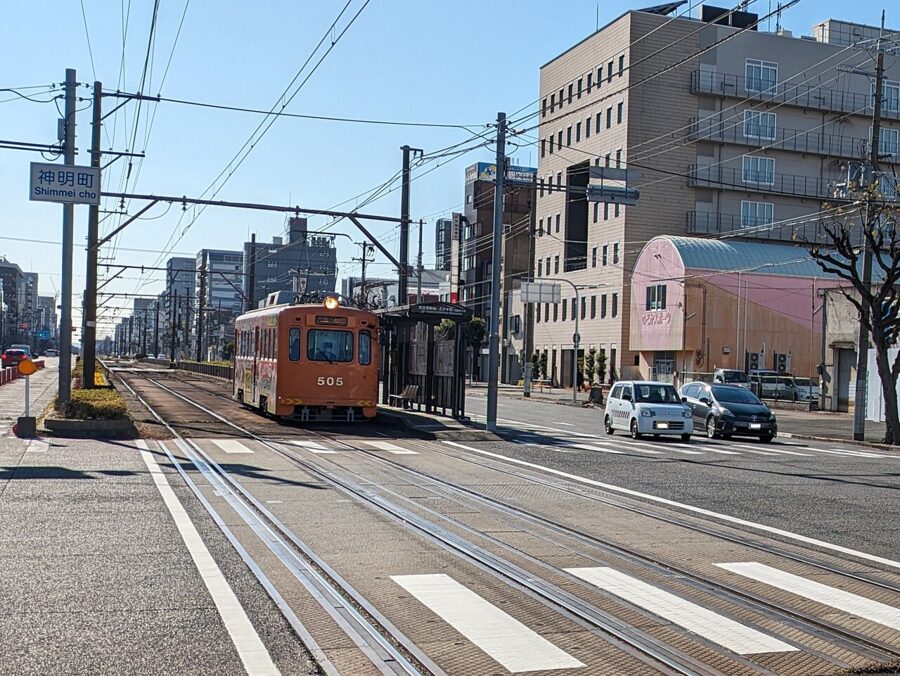
The shop is two minutes from Shinmeicho on the Hankai tram. Osaka’s official visitor site books it from about ¥18,750 (about $115), with a dearer plan that adds an English interpreter, which the shop asks anyone without good Japanese to choose, since the class involves blades and fire.

Sanjo Kaji Dojo: walk-in sessions
For the price of a coffee, Sanjo Kaji Dojo puts a hammer in your hand. Every open day, mornings from 9:00 and afternoons from 13:00, it takes walk-ins for forging a square nail, wakugi, hammering a big nail into a letter opener, and sharpening a knife you bring. You can also buy a semi-finished knife, give it its edge and take it home.
Since 1 April 2026 visitors from outside Sanjo pay ¥770 (about $5) for nails or sharpening and ¥2,200 (about $13) for the letter opener. Longer courses with master smiths, chosen by lottery, included a half-day santoku in October 2026; each is announced about two months ahead.

What to wear, what to bring, and getting the knife home
Wear long sleeves, long trousers and closed shoes; Sanjo Kaji Dojo turns away sandals. Workshop Kurogane lends safety glasses, ear protection and aprons; wherever you go, bring a towel, because a forge is hot even in winter. Takefu’s classes are for 18 and up, so check age limits before booking with children.
Japan’s swords and firearms law forbids carrying a blade over 6 centimeters without a legitimate reason, and taking home a knife you have just made or bought is one. Keep it boxed and bagged until the hotel. Knives cannot go in cabin baggage; pack yours in checked luggage, sheathed or wrapped in cardboard.
Buying direct from the smith
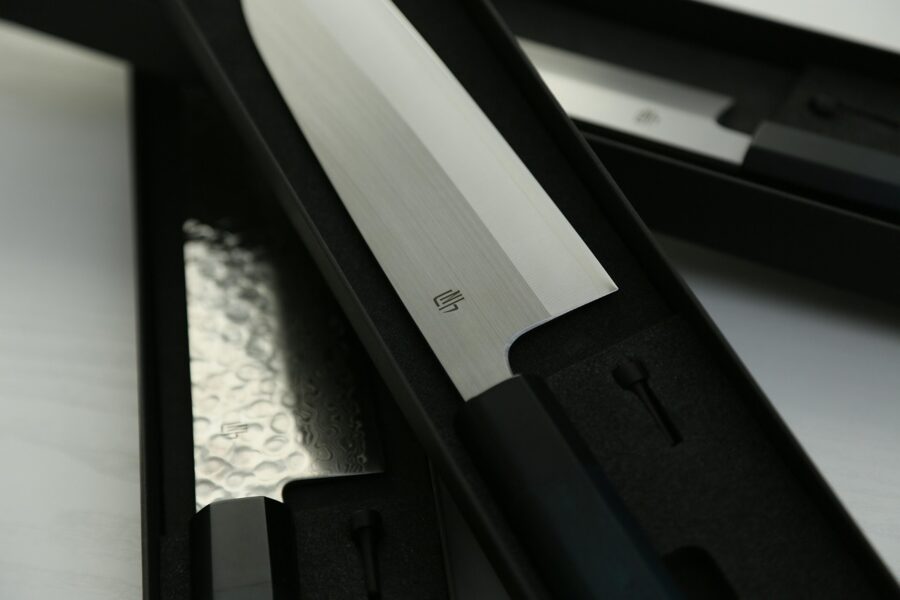
The workshop shops are the best places to buy after a class, because the maker may be behind the counter. Takefu Knife Village sells its members’ knives tax-free to visitors with a passport, Asano Kajiya and Workshop Kurogane sell online, and Sakai Densho-kan stocks the city’s workshops.
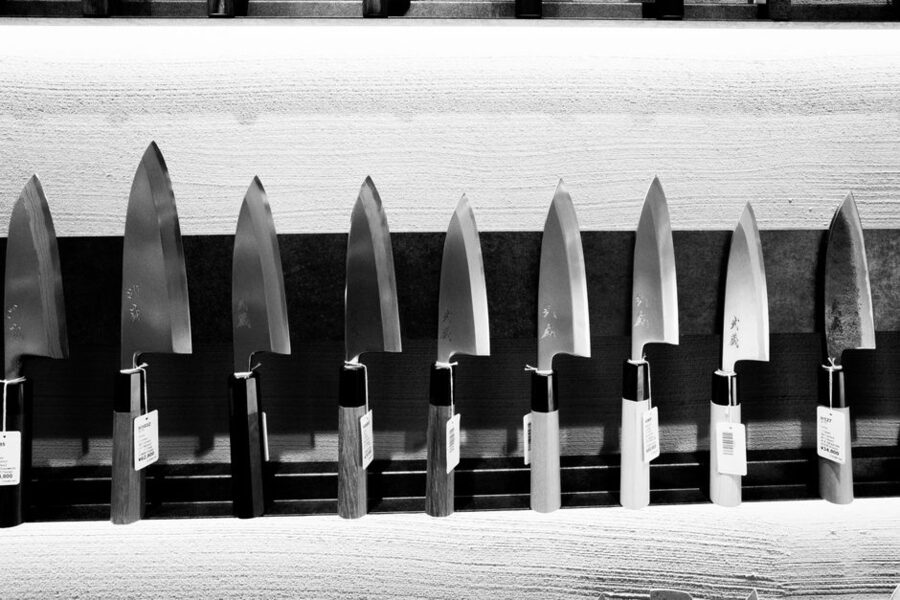
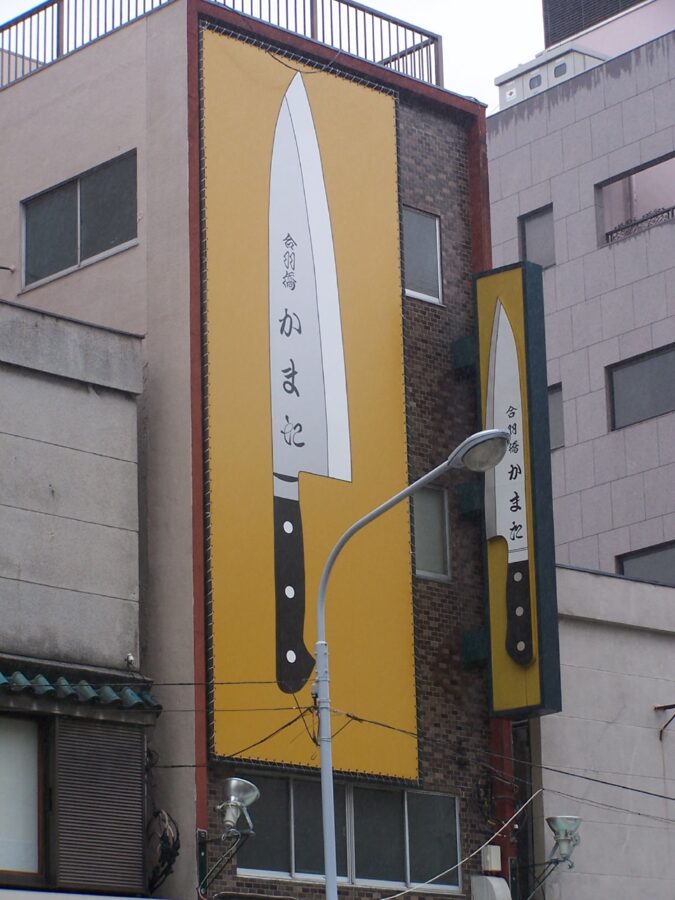
Ask two questions anywhere: who forged it, and who sharpened it. In Sakai two names is a good answer, and “堺打刃物” on the box is a regional trademark only registered Sakai makers may use. In Tokyo and Kyoto the old dealers, Kamata Hakensha on Kappabashi and Aritsugu in Nishiki Market, stock many makers, and Kamata carves your name on the blade while you wait, a service called na-ire (名入れ).



Back to that Sakai deba. Turn one over in a shop and you will see the hollow in its back, the misty line where iron meets steel, and the mark of whoever forged it. After a day at a forge you will know what each of those took, and which of them you could do yourself.